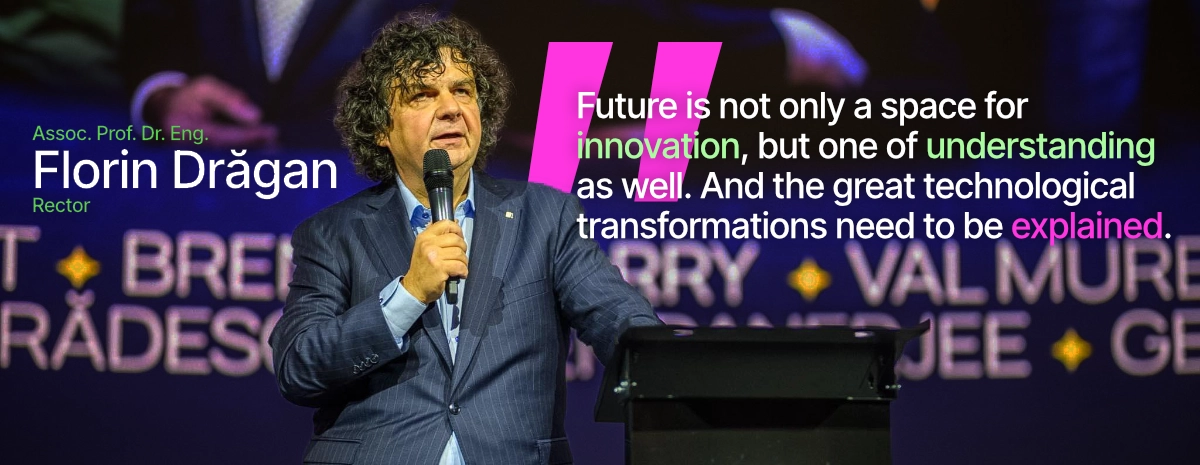
Technology, education and the future, led by Politehnica University Timișoara

Technology, education and the future, led by Politehnica University Timișoara

Every generation hopes to find its place in a changing world. For young people today, that search unfolds in aperiod of extraordinary technological acceleration. Artificial intelligence is reshaping how ideas are developed, how organizations operate, and how professions evolve. The rhythm is faster, the tools are more powerful, and the horizon is wider than before.
That is precisely why this is such an important moment to ask a meaningful question: what should young people invest in learning now, so they can grow into lives of substance, relevance, and contribution?
This question carries weight far beyond career planning. It touches the deeper relationship between education and character, between competence and responsibility, between opportunity and purpose. For students, it speaks to the kind of path worth building. For universities, it raises the question of what deserves to be cultivated with seriousness. For employers, it invites a richer understanding of talent and long-term potential.
Some forms of learning will remain foundational in every scenario. Technical fluency, intellectual discipline, and professional rigor continue to matter deeply. Young people who understand how intelligent systems work, how they are used, and how they shape decisions will carry an important advantage. AI literacy is quickly becoming part of contemporary literacy itself. The ability to work with advanced tools, formulate strong prompts, verify outputs, and integrate technology into meaningful work will increasingly open doors across fields.
Alongside these skills, a second layer of development becomes especially valuable: the cultivation of qualities that deepen over time and travel well across professions, industries, and moments of change.
One of these is human judgment. In environments rich in information, judgment gives direction. It allows a person to recognize what matters most, read context carefully, weigh complexity, and act with maturity. A student may use AI to explore a difficult topic more quickly. A young engineer may accelerate a design process. A junior analyst may organize large volumes of information with impressive efficiency. Real professional depth begins to emerge when a person can identify the essential question, evaluate the quality of an answer, understand consequences, and choose wisely.
Judgment brings together knowledge, timing, perception, and responsibility. It gives shape to leadership early in life, long before formal authority appears.
A second investment of lasting value is communication. Clear expression, attentive listening, and the ability to create shared understanding have become central forms of intelligence in their own right. Every organization needs people who can connect ideas, explain complexity with precision, and build trust across disciplines, backgrounds, and priorities. Communication gives movement to knowledge. It allows expertise to become useful, collaborative, and transformative. This quality matters in every domain. In healthcare, it supports trust between professional and patient. In business, it strengthens teams, decisions, and partnerships. In engineering, it helps turn technical insight into real-world adoption. In public life, it gives clarity and credibility to ideas that shape communities. Young people who learn to communicate with substance and composure will remain valuable in any environment they enter.
A third area worth cultivating is the capacity to work across boundaries. Many of the most important questions of the coming decade will live at the intersection of disciplines. Innovation grows where engineering meets design, where data meets ethics, where sciencemeets policy, and where technical excellence meets human understanding. Young people who develop intellectual curiosity beyond a single field will be especially well positioned to contribute meaningfully.
This kind of breadth enriches professional life in practical ways. It helps a researcher understand social implications. It helps an entrepreneur see cultural context. It helps a policymaker appreciate technological realities. It helps a designer think structurally. Interdisciplinary thinking expands the range of problems a person can engage with and the quality of solutions they can help create.
Equally important is initiative. The future will offer remarkable tools and new possibilities for action. Initiative gives those possibilities a direction. It is visible in people who begin, who test ideas, who stay engaged with a problem long enough to understand it deeply, and who carry energy into uncertain territory. Initiative creates momentum. It transforms potential into contribution.
For young people, this means that learning acquires a broader meaning. It includes study, certainly, and also experience. It grows through demanding projects, research, mentorship, internships, teamwork, civic involvement, entrepreneurial experiments, and environments that strengthen both competence and character. These experiences contribute to more than employability. They shape steadiness, perspective, and maturity.
For universities, this moment offers a powerful opportunity. Higher education can serve as a place where knowledge, judgment, curiosity, and responsibility are formed together. It can become an environment where students develop intellectual confidence, ethical seriousness, and the courage to contribute thoughtfully to a changing world. The strongest education prepares people for meaningful participation in reality as it unfolds.
For employers, the same moment invites a wider lens on talent. Professional readiness will always matter. So will curiosity, initiative, reliability, and the capacity for growth. Organizations that recognize these qualities early, and create spaces where they can mature, will strengthen their own future as well.
For young people, there is something deeply encouraging in all of this. A meaningful future remains open to those who approach learning with seriousness, humility, and consistency. Relevance grows through attention. Confidence grows through practice. Depth grows through sustained effort. Over time, competence and character begin to reinforce eachother.
At Tech Talks by UPT 2026, under the theme “Irreplaceable”, this question stands at the center of a larger conversation: how do we help young people grow into forms of value that remain strong in a world shaped by intelligent technologies? What should education nourish? What should institutions encourage? What should each person begin to cultivate with greater intention?
On May 15, in Timișoara, we invite you to join this conversation with openness, seriousness, and hope. The future will be shaped by extraordinary technologies. It will also be shaped by people whose judgment brings direction, whose creativity brings meaning, and whose responsibility gives lasting value to progress.